
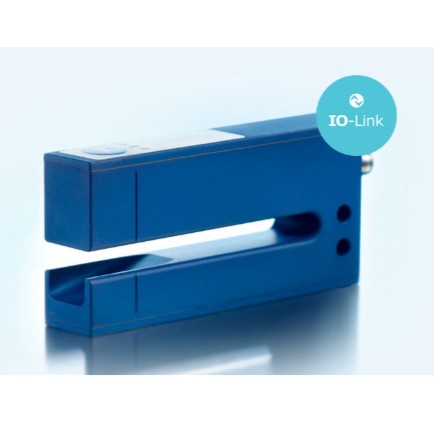
Label and Splice

Ultrasonic, Capacitive & Optical Sensors for Label, Gap & Splice Detection

Label and splice detection can require different sensing technologies depending on the label material, backing material, transparency, optical contrast, thickness, web speed, and mounting requirements.

IBIS Electro-Products supplies ultrasonic, capacitive, and optical label sensors for applications including label presence detection, gap detection, splice detection, label counting, and web monitoring. Selecting the appropriate sensing technology helps improve detection reliability across paper, film, transparent, reflective, metallised, foil, and other label materials.

Choose a Label & Splice Sensor Technology

Microsonic esf+1 Ultraschall-Etikettensensoren esf+1 ultrasonic label sensor

Ultrasonic Label & Splice Sensors

Ultrasonic sensors detect changes in sound transmission through the label, backing material, or web. They are particularly useful where transparency, reflectivity, metallisation, colour, or low optical contrast can make optical detection difficult.

Available solutions include Microsonic esf+1, esf-1, and esp-4 families along with selected di-soric ultrasonic label sensors. Depending on the model, features include IO-Link, Teach-in, Push-Pull outputs, different fork dimensions, and configurations for label, splice, gap, and web-break monitoring.

View Products
Optical Label Sensors

Optical Label & Splice Sensors

Optical label sensors detect differences in optical contrast or light transmission between the label, backing material, and gap.

They are well suited to paper, film, and other label materials where a consistent optical difference can be detected quickly and repeatedly. Different fork openings, sensing depths, connection options, and Teach-in arrangements allow the sensor to be matched to the application.

View Products
Capacitive Label Sensors

Capacitive Label Sensors

Capacitive sensors detect differences in dielectric properties between the label and backing material. This sensing principle can be well suited to transparent labels, foil labels, thin paper labels, and other materials where optical appearance alone may not provide a dependable detection signal.

Current di-soric models are available with different fork openings, internal leg lengths, connector arrangements, and IO-Link capability for a range of labelling-machine requirements.

View Products

How the Label & Splice Sensor Technologies Differ

The best sensing technology depends primarily on the physical difference available between the label and its backing material.

Ultrasonic

Choose ultrasonic sensing when colour, transparency, reflectivity, metallisation, or optical appearance may make optical detection unreliable. Ultrasonic sensors evaluate changes in sound transmission through the material and are widely used for difficult label and splice applications.

Capacitive

Choose capacitive sensing when the label and backing material provide a useful difference in dielectric properties. Capacitive sensing can be particularly effective with transparent, foil, paper, and other thin label materials.

Optical

Choose optical sensing when the label, gap, mark, or backing material provides a stable difference in optical contrast or light transmission. Optical sensing provides a straightforward solution where the material can be reliably distinguished optically.

Typical Applications

Label and splice sensors are well suited to:

  • Label presence and gap detection
  • Label counting
  • Transparent label detection
  • Paper and film label detection
  • Reflective and metallised label detection
  • Foil label detection
  • Splice and seam detection
  • Web-break monitoring
  • Labelling machines
  • Print-and-apply systems
  • Packaging machinery
  • Converting equipment
  • Paper, plastic-film, and metal web processing
  • Automated material-feed applications

How to Choose the Right Label & Splice Sensor Technology

Start with the label and backing-material combination.

Choose ultrasonic when the material may be transparent, reflective, metallised, low contrast, or otherwise difficult to distinguish optically.

Choose capacitive when a reliable difference in dielectric properties exists between the label and backing material.

Choose optical when the label, gap, or backing material provides a consistent optical contrast or light-transmission difference.

Then consider:

  • label and backing-material type
  • transparency and reflectivity
  • material thickness
  • label spacing and web speed
  • required fork opening
  • required sensing depth
  • mounting space
  • switching-output requirements
  • IO-Link availability
  • Teach-in method
  • connector configuration
  • production-changeover requirements

For difficult applications, material testing may be useful before final sensor selection.

Need Help Selecting a Label & Splice Sensor?

IBIS Electro-Products can help compare ultrasonic, capacitive, and optical label sensors based on material type, sensing technology, fork dimensions, outputs, IO-Link availability, mounting requirements, and application conditions.

Frequently Asked Questions About Label & Splice Sensors

IBIS offers ultrasonic, capacitive, and optical label-sensing technologies. The appropriate method depends on the label material, backing material, transparency, optical contrast, dielectric properties, machine speed, and installation requirements.

Ultrasonic sensing is particularly useful when transparent, reflective, metallised, glossy, or low-contrast materials make optical detection difficult. It detects changes in ultrasonic transmission rather than relying primarily on colour or appearance.

Capacitive sensing can be a good choice when the label and backing material provide a reliable difference in dielectric properties. It can be useful for transparent, foil, paper, and other thin label materials.

Optical sensing is well suited where the label, gap, or backing material provides a consistent optical contrast or light-transmission difference that can be detected reliably.

Yes. Depending on the sensor technology and model, label sensors can also be used for splice, seam, web-break, or material-transition detection. The sensor should be selected according to the material thickness, sensing principle, and application requirements.

No. IO-Link availability depends on the sensor family and model. Several current ultrasonic and capacitive models support IO-Link, while other models use conventional switching outputs, Teach-in, or remote configuration methods.