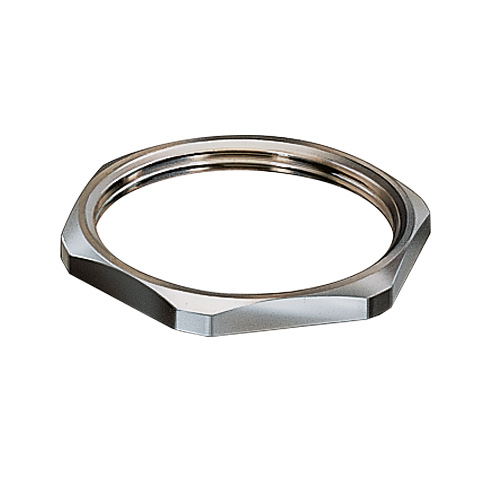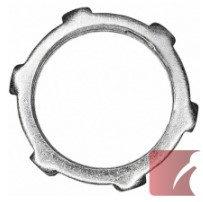
Locknuts
Locknuts and Counternuts for Securing Conduit Fittings
Locknuts, sometimes called counternuts, are used to secure threaded conduit fittings to panels, enclosures, junction boxes, and machine components.
These components fasten the conduit fitting to the mounting surface using the fitting’s threaded hub. Once tightened, the locknut clamps the fitting securely against the enclosure wall, ensuring proper mechanical retention and alignment of the conduit connection.
Locknuts are available in several materials depending on the conduit system and installation environment. Nickel-plated brass locknuts are commonly used with both metal and plastic threaded fittings, while nylon locknuts are typically used with plastic threaded fittings. Galvanized steel locknuts are frequently used in NPT conduit systems and heavy-duty installations.
Special hinged locknuts are also available for use with openable conduit systems designed for maintenance and retrofit wiring installations where cables cannot be disconnected.
FLEXAquick® quick-connect fittings and ROHRflex® flexible corrugated conduits are flagship product lines from IBIS Electro-Products Corp., specializing in high-performance electrical conduit systems.
Choosing the Right Locknut
| Product | Material | Thread Type | Typical Use |
|---|---|---|---|
| GM-M | Nickel-plated brass | Metric | Securing metric threaded conduit fittings to panels or enclosures |
| GM-N | Nickel-plated brass | NPT | Securing NPT threaded conduit fittings to panels or enclosures |
| GM-P | Nickel-plated brass | PG | Securing PG threaded conduit fittings to panels or enclosures |
| GMK-M | Nylon plastic | Metric | Securing plastic threaded conduit fittings |
| GMK-N | Nylon plastic | NPT | Securing plastic threaded conduit fittings |
| GMK-P | Nylon plastic | PG | Securing plastic threaded conduit fittings |
| LN | Galvanized steel | NPT | Heavy-duty installations securing threaded conduit fittings |
| GMK-DUO-M | Hinged nylon | Metric | Used with ROHRflex DUO openable conduit fittings |
How Locknuts Work
Locknuts are threaded nuts used to secure conduit fittings to electrical panels, junction boxes, and equipment enclosures.
The conduit fitting is inserted through a panel opening, and the locknut is threaded onto the fitting hub from the inside of the enclosure. Tightening the locknut clamps the fitting securely against the enclosure wall, holding the fitting in place.
The conduit is then attached to the fitting, allowing the conduit system to be securely mounted to the enclosure or machine structure.
Depending on the installation environment, locknuts may be made from brass, nylon plastic, or steel to provide the appropriate strength, corrosion resistance, or electrical characteristics.
Hinged locknuts are designed for openable conduit systems and allow installation around existing wiring without disconnecting cables.
Typical applications include:
• Industrial automation systems
• Machine wiring and control panels
• Retrofit conduit installations
• Maintenance and repair cable protection
• Openable conduit systems for in-place wiring
• Electrical panel and enclosure installations
Frequently Asked Questions About Locknuts
When should nickel-plated brass locknuts be used?
Nickel-plated brass locknuts are commonly used with both metal and plastic threaded conduit fittings. The brass provides reliable mechanical strength, while the nickel plating improves corrosion resistance and surface durability. These locknuts are widely used in industrial environments where long-term reliability and resistance to moisture or contaminants are important.
When should nylon locknuts be used?
Nylon locknuts are typically used with plastic threaded conduit fittings. They provide corrosion resistance, electrical insulation, and are well suited for lightweight conduit installations.
When are galvanized steel locknuts used?
Galvanized steel locknuts are commonly used in heavy-duty installations, particularly with NPT threaded conduit fittings. The galvanized coating provides corrosion resistance while the steel construction offers high mechanical strength.
What are hinged locknuts used for?
Hinged locknuts are designed for openable conduits such as ROHRflex Duo and openable conduit fittings like the RQG-Duo. They allow the locknut to be installed around existing wiring without disconnecting cables, making them ideal for maintenance and retrofit applications.
Do locknuts secure the conduit?
No. Locknuts secure the conduit fitting to a panel, enclosure, or machine component. The conduit is then connected to the fitting, completing the conduit installation.
Can locknuts be used with cord grips, cable glands, and strain relief fittings?
Yes. Locknuts can be used with many threaded electrical components, including cord grips, cable glands, strain relief fittings, and conduit fittings.
Locknuts are used to secure these threaded devices to panels, enclosures, junction boxes, and machine housings. When tightened, the locknut clamps the fitting securely against the mounting surface, helping maintain proper mechanical retention and alignment of the threaded connection.
For best results, the thread type and locknut material should match the fitting and installation environment.
Do locknuts need sealing washers for outdoor or wet locations?
In many installations, especially outdoor or washdown environments, locknuts are used together with sealing washers to provide environmental protection. The sealing washer is placed between the fitting and the enclosure wall to create a barrier against moisture, dust, and contaminants.
The locknut then secures the threaded fitting in place from the inside of the enclosure, compressing the sealing washer and helping maintain a reliable mechanical connection.
Using both components together helps ensure proper environmental sealing and mechanical retention of the conduit fitting.
Need help selecting the right locknut?
Our technical team can help you select the correct locknuts for your conduit fitting installation.